The Hidden Cost of Owner Dependency in Small Business
(And how it quietly creates business bottlenecks)
One of the most common and most expensive problems I see in small and mid-sized businesses is owner dependency.
It rarely shows up on a profit and loss statement.
It doesn’t always look like a problem day-to-day.
And yet, it quietly caps growth, drains profit, and exhausts the owner.
Let’s talk honestly about owner dependency in business, why it creates serious business bottlenecks, and why it’s often the real issue hiding behind “busy but stuck” businesses.
What is owner dependency in business? (quick definition)
Owner dependency occurs when a business relies too heavily on the owner for decisions, problem-solving, approvals, or delivery of work.
In owner-dependent businesses:
The owner is the go-to for everything
Decisions slow when the owner is unavailable
Staff wait instead of acting
Progress stalls without the owner’s direct involvement
The business may still function but it can’t scale, simplify, or improve profit properly.
Why owner dependency feels normal (at first)
Most owner dependency starts with good intentions.
You built the business.
You know the clients.
You care about quality.
You’re capable and reliable.
So naturally:
You step in to help
You solve problems quickly
You make the final call
You keep things moving
In the early stages, this works.
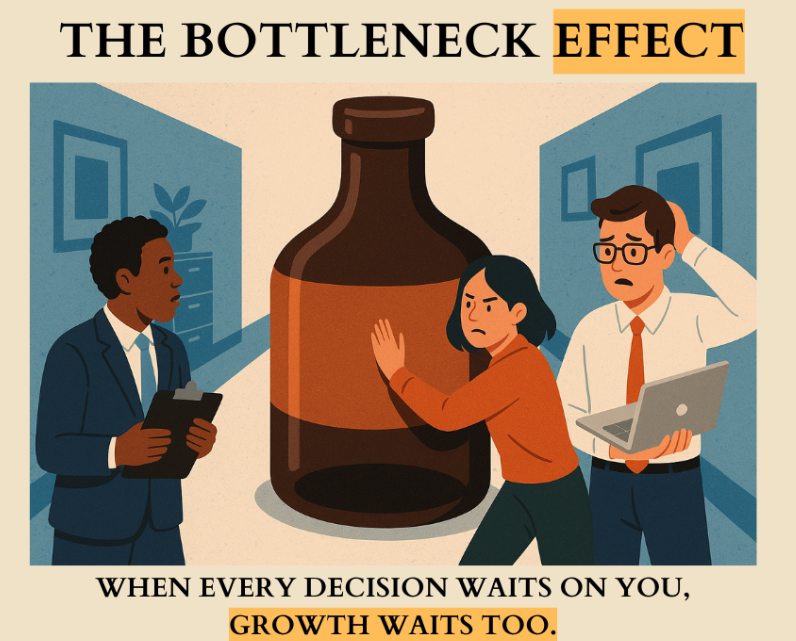
But as the business grows, what once created momentum becomes a business bottleneck.
How owner dependency creates business bottlenecks
A bottleneck is any point where work slows, queues, or stops.
In owner-dependent businesses, the bottleneck is often the owner.
Example 1: The decision bottleneck
A client issue arises.
The team waits for the owner.
The owner is in meetings, travelling, or firefighting elsewhere.
What should take minutes takes days.
Multiply this across dozens of small decisions, and productivity quietly collapses.
Example 2: The quality bottleneck
The owner insists on checking everything:
Quotes
Proposals
Work outputs
Client communication
Quality stays high but speed, scale, and profit suffer.
The business becomes dependent on the owner’s time rather than capable systems.
Example 3: The problem-solving bottleneck

Staff escalate issues because:
Authority isn’t clear
Processes aren’t defined
Past decisions weren’t documented
So the owner becomes the default fixer.
This trains the team not to think and reinforces dependency.
The hidden cost of owner dependency (this is where profit leaks)
Owner dependency doesn’t just create frustration it creates real financial cost.
1. The owner becomes the most expensive employee
Highly paid, highly skilled time is spent:
Answering routine questions
Fixing avoidable errors
Doing work others could handle with clarity
That’s a direct hit to profit.
2. Growth slows — without anyone noticing why
The business looks busy.
Revenue may still grow.
But results plateau because capacity is capped by the owner.
This is a common reason business profit isn’t increasing, even when sales are.
(Internal link opportunity: “Why Busy Businesses Still Struggle With Profit”)
3. Improvement never sticks
Even when changes are made:
Systems aren’t followed consistently
Decisions revert to the owner
Old habits return
Without reducing owner dependency, improvements rely on constant effort instead of structure.
A real pattern I see in Business Analysis work

Business owners often come to me saying:
“I just need better staff.”
But once we analyse the business properly, we find:
Staff don’t have clear authority
Processes rely on the owner’s memory
Decisions aren’t documented
Accountability isn’t structured
The issue isn’t people.
It’s owner dependency creating business bottlenecks.
This is exactly the kind of insight that comes from a structured Business Analysis, not guesswork.
Business Analysis service page
Why owner dependency is so hard to see from the inside
Owner dependency hides behind:
“It’s faster if I just do it”
“They’re not ready yet”
“It’s quicker if I decide”
“I’ll fix the system later”
But later rarely comes because the owner is too busy holding everything together.
How to reduce owner dependency (properly)
This is not about stepping back and hoping for the best.
Reducing owner dependency requires:
Clear decision frameworks
Defined roles and authority
Simple, workable processes
Visibility over where decisions and work stall
Most importantly, it requires knowing where dependency is actually occurring not guessing.
That’s why this work almost always starts with a Business Analysis.
Owner dependency and business bottlenecks (summary)
Owner dependency in business creates bottlenecks when:
Decisions rely on one person
Authority is unclear
Processes live in the owner’s head
Quality control replaces capability building
The owner becomes the default solution
The result is a business that looks busy but struggles to scale, simplify, or improve profit.

This is exactly what a Business Analysis uncovers
A Business Analysis identifies:
Where the owner is the bottleneck
Which decisions slow the business
Where authority and process break down
What needs to change first to unlock capacity
Not theory.
Not blame.
Clear insight and a practical path forward.
👉 This is exactly what a Business Analysis uncovers.
Why Busy Businesses Still Struggle With Profit
Business Management Training – Guide for Business Owners
Read more about Owner Load, Time Burnout & Sustainability here.