Revenue Is Up but Profit Is Down: Why More Sales Can Leave You With Less Money
Growing sales should be good news.
But there is a point where some business owners look at the revenue figure, look at the bank account and realise the two do not seem to match.
The business is busier. The team is doing more. Sales have increased.
Yet somehow there is less money left.
This happens more often than many business owners expect.
Sales can rise while profit falls when the margin on each sale shrinks or the cost of running the business grows faster than revenue.
If I was looking at a business in this position, I would start with gross margin, net margin, labour as a percentage of revenue, actual selling price, profitability by product or customer and growth in overheads.
Revenue tells you how much you sold.
Margin tells you how much of it you kept.
More revenue does not automatically mean more profit

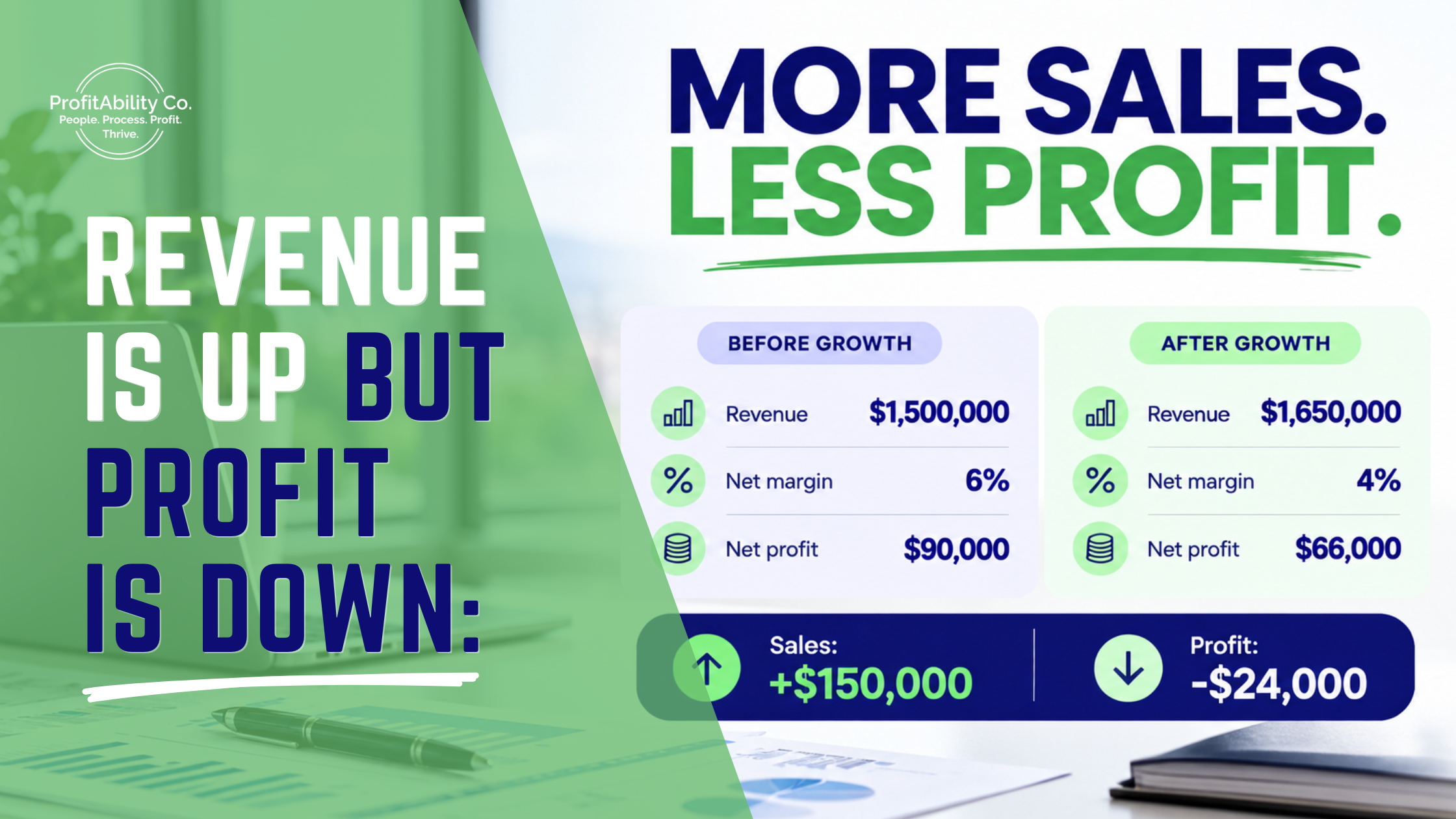
Take a business turning over $1.5 million.
At a 6% net profit margin, it is making $90,000 in net profit.
Now imagine sales increase by 10%.
Revenue grows to $1.65 million.
On the surface, that looks like progress.
But during that growth the business needs more staff. Wages rise. Discounts creep in. Delivery costs increase. A few extra software subscriptions are added and other costs gradually move up.
Net margin falls from 6% to 4%.
The business is now making $66,000 in net profit.
Revenue increased by $150,000.
Profit fell by $24,000.
That is why turnover on its own tells me very little about the health of a business.
A business can become bigger, busier and more complicated without becoming more profitable.
Revenue and profit are telling you two different things
Revenue measures sales.
Profit measures what is left after the costs required to generate those sales have been paid.
That sounds obvious, but businesses often manage growth around the revenue number.
More customers. More jobs. More appointments. More transactions. More locations. More staff. More turnover.
All of those numbers can move in the right direction while profitability quietly moves the other way.
I would always want to know what is happening underneath the revenue figure.
What happened to your margin over the past 12 months?
What happened over 24 months?
What changed as revenue grew?
That usually tells me far more than the headline sales figure.
Your Australian business benchmarks can provide useful context, but I would also compare the business against itself.
Start with margin, not turnover
When revenue increases without a similar increase in profit, margin is one of the first places I look.
There are two useful numbers here.
Gross margin tells you what remains after the direct costs associated with producing or delivering what you sell.
Net margin tells you what remains after the broader costs of running the business are included.
If either percentage is falling while revenue is growing, there is something worth investigating.
Supplier costs may have increased. Prices may not have moved with costs. Discounting may have increased. Delivery might be taking longer. Labour may be costing more for each sale.
Or the business may simply be doing more low-margin work.
There is no single net profit margin that is right for every business. Industry, business model, size and cost structure all matter.
That is why I prefer to look at relevant net profit margin benchmarks by industry and then compare them with the business's own trend.
The direction of the number matters.
Check what you are actually selling more of
Not all revenue is equal.
This is one of the biggest mistakes I see in businesses that focus heavily on turnover.
Imagine you sell two services.
Service A generates $1,000 in revenue and contributes $400 towards overhead and profit.
Service B also generates $1,000 in revenue but contributes only $100.
If you sell another 100 units of Service B, revenue increases by $100,000.
But you have only created $10,000 in additional contribution.
Sell another 100 units of Service A and the same $100,000 of additional revenue creates $40,000 in contribution.
The top-line growth is identical.
The commercial result is completely different.
This is why I want to know where the growth came from.
Which products grew? Which services grew? Which customers grew? Which jobs are taking more time?
Which parts of the business are actually making money?
A business can have its best sales year ever because its least profitable work grew the fastest.
That is not the growth I would be celebrating.
Look at labour before assuming you need more sales

Labour is another area where growth can quietly consume profit.
A growing business often adds people before it fully understands what the additional revenue is producing.
Another employee is hired.
Then another.
Overtime increases.
Administration expands.
A manager is added.
The owner is still working just as hard as before.
Before long, the business has a much bigger wage bill without a proportionate improvement in profitability or owner capacity.
The figure I would look at is not simply total wages.
I would look at labour cost as a percentage of revenue.
If revenue increased by 10% but labour increased by 20%, I would want to understand why.
Sometimes there is a perfectly reasonable explanation.
The business may have hired ahead of expected growth. It may be building capacity. It may be replacing work previously done by the owner.
The problem is not automatically the extra employee.
The problem is not knowing whether that extra cost is creating the result you expected.
Work out what customers are actually paying
Your price list and your actual selling price are not always the same thing.
A business might advertise a service for $1,000.
That does not mean the average customer pays $1,000.
I would look at what happens after the published price.
Discounts. Promotions. Negotiated rates. Credits. Refunds. Packages. Free extras.
Then there is scope that gets added without being charged.
Small pricing decisions add up.
A business might have increased its headline prices while its actual realised price has barely changed.
That gap matters.
You need to know what customers actually pay, not what the price list says they should pay.
Matching a competitor's price does not tell you whether that price works for your business.
Your price needs to cover the cost of delivering the work, contribute to your overheads and leave the profit margin the business needs.
Growth usually brings overhead with it
Revenue rarely grows without something else growing beside it.
More sales can require additional staff, software, equipment, vehicles, storage, premises, management, administration, marketing and systems.
Some of that investment is necessary.
There is nothing wrong with spending money to support growth.
The question is whether the additional gross profit created by the growth is greater than the additional cost required to support it.
A $200,000 increase in revenue sounds impressive.
It becomes less impressive if the business needed $220,000 in additional costs to produce it.
Growing an unprofitable business just gives you a bigger unprofitable business.
That is why I would fix the economics of what is already happening before chasing more volume.
Sometimes profit falls before growth pays off
A temporary decline in profit is not always bad.
There are times when a business deliberately spends ahead of growth.
You might hire someone six months before you need their full capacity.
You might purchase equipment that allows the business to produce more later.
You may invest in systems, premises or technology.
Those decisions can reduce profit in the short term.
That can be perfectly sensible.
The distinction for me is whether the decline was planned and measured or whether it was discovered afterwards.
If you deliberately invest $100,000 and have a clear commercial reason for doing it, that is very different from reaching the end of the year and wondering where $100,000 of profit went.
A temporary reduction in profit can be an investment.
An unexplained reduction in profit is a warning.
The numbers I would ask for first
When sales are increasing but profit is not, I do not want another marketing report first.
I want the numbers that explain what is happening inside the business.
| Number | What it tells me |
|---|---|
| Revenue growth | How quickly sales have changed |
| Gross margin % | Whether the basic economics of what you sell are holding |
| Net margin % | Whether growth is producing actual profit |
| Labour % of revenue | Whether people costs are increasing faster than sales |
| Average realised selling price | What customers actually pay after discounts and adjustments |
| Profit by product or service | Whether growth is coming from profitable work |
| Profit by customer or customer type | Whether high-revenue customers are genuinely valuable |
| Overheads year-on-year | Whether additional complexity is consuming the gain |
I would want at least 12 months of data. Preferably 24. One month can mislead you.
A trend is much harder to argue with. That is why I say the numbers tell the story.
You just need to make sure you are looking at the right numbers.
The number I learned to watch in my own business
I learned this from running businesses myself.
In one of my businesses, I stopped looking only at total revenue and started watching profit at a much more detailed level.
One of the measures I tracked increased from $1 to $3.
That is a 200% increase.
Revenue also increased, but revenue was not the only number I cared about.
I wanted to understand what each additional sale was actually worth to the business.
That changes the conversation.
Instead of asking:
How do we sell more?
I start asking:
What do we make when we sell more?
That distinction matters in almost every business.
Depending on what you do, the useful measure might be profit per job, profit per client, profit per appointment, profit per table, profit per project, profit per vehicle or profit per unit sold.
There will usually be a number underneath revenue that tells you much more about how well the business is really performing.
Finding it is often where the useful work starts.
Can sales increase while profit decreases?

Yes.
I am working with a client right now whose sales have grown by around 30%, yet the owner is not seeing that growth reflected in the bank account.
Cash and profit are not the same thing, so that alone does not prove the business has become less profitable.
But it is a clear signal that we need to look underneath the sales number.
As revenue grew, so did the cost base.
Another staff member. Another vehicle. More equipment. More supplies.
More sales created more activity, but more activity also created more cost.
The answer is not automatically to chase another 30% in sales.
I would review the costs, purchasing, pricing, margins and cash movements first.
Competing with another business does not make your price profitable.
Your numbers have to work for your business.
Why is my business busy but not profitable?
A busy business is not automatically a profitable business.
Low margins, poor pricing, excessive labour costs, high overheads and an unprofitable product or customer mix can all create a business that feels extremely busy while producing very little profit.
The answer is not automatically more sales.
I would first find out what the existing sales are actually producing.
Which is more important, revenue or profit?
They measure different things.
Revenue tells you how much the business sold.
Profit tells you what remained after the costs of making those sales.
A healthy business needs enough revenue and enough margin.
I would not use either number in isolation.
What is a good net profit margin for an Australian business?
There is no single percentage that applies to every Australian business.
Industry, turnover, labour requirements, premises, stock levels and business model can all affect what a reasonable margin looks like.
I would compare the business with relevant industry benchmarks and then look closely at its own margin trend over time.
You can see more in my net profit margin benchmarks for Australian businesses.
How do I know which products or customers are profitable?
Start by understanding the revenue and direct costs associated with each product, service or customer group.
Then calculate what each contributes towards overhead and profit.
High revenue does not necessarily mean high profitability.
A large customer can look valuable while absorbing significant labour, discounts, delivery costs or management time.
That is why I prefer to measure commercial contribution rather than simply ranking customers by sales.
Can rapid business growth temporarily reduce profit?
Yes.
Hiring ahead of demand, buying equipment or building additional capacity can temporarily reduce profit.
That is not necessarily a problem.
The important question is whether the investment was planned, measured and expected to produce a reasonable return.
If profit falls unexpectedly as sales grow, I would investigate rather than assume growth will eventually fix it.

If the numbers do not make sense, start there
If revenue is growing but the money is not showing up in profit, I would not start with another sales campaign.
I would find out where the margin is going.
That is what a Business Analysis is designed to do.
It looks across the numbers, operations, people and sales activity to identify what is actually happening and what needs fixing first.