Brainstorming and Feedback Culture for Productivity
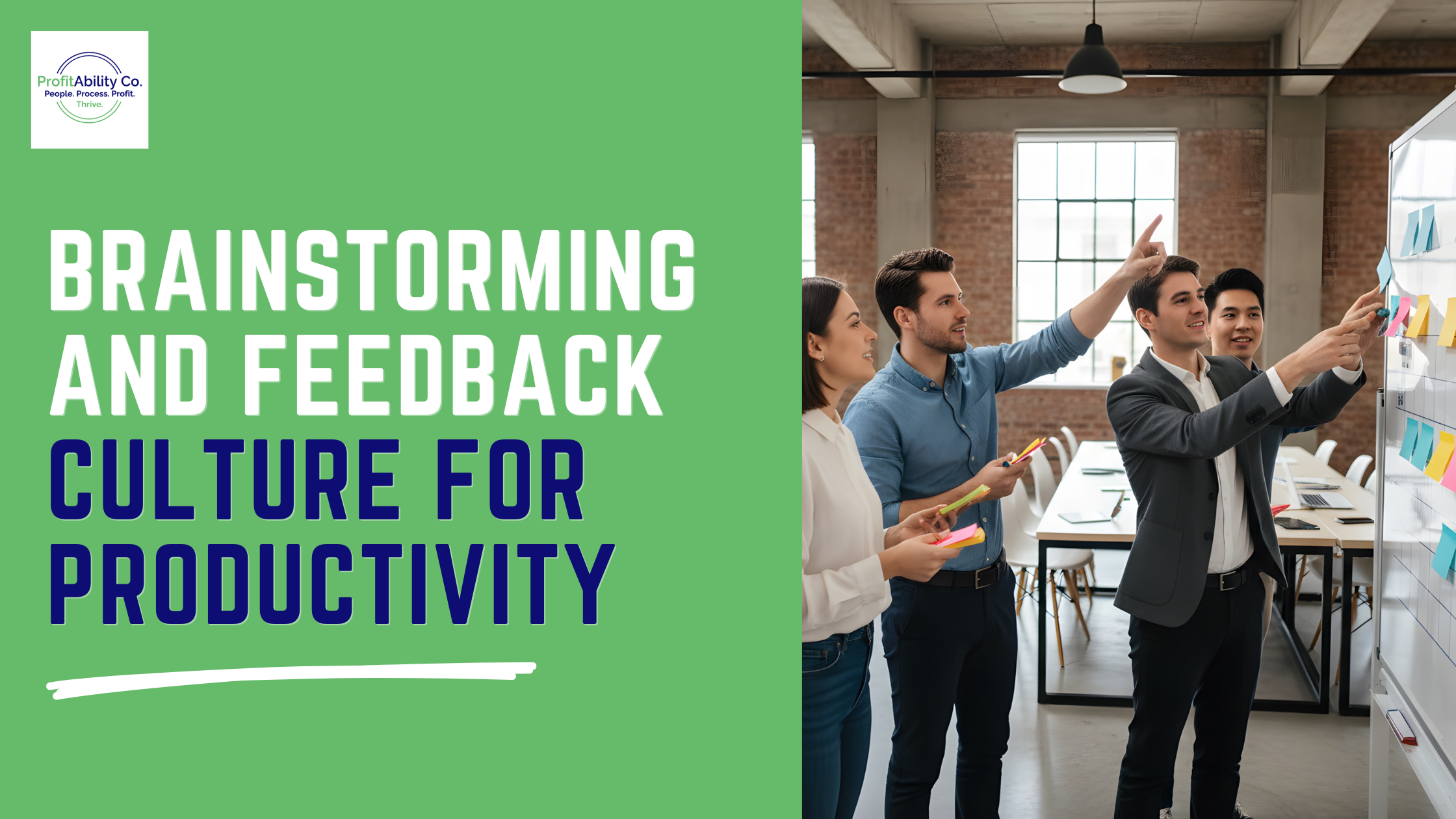
How Tapping Into Your Team’s Everyday Ideas Drives Real Business Results

One of the most common things I hear from business owners is
“My team just doesn’t think strategically.”
And almost every time, that belief is costing the business money.
In reality, the people closest to the work often hold the clearest insight into what is slowing things down, frustrating customers, and creating unnecessary effort. The problem is not capability. The problem is that their ideas are rarely captured, structured, or acted on.
That is exactly what this resource, Brainstorming and Feedback Culture for Productivity, is designed to address. It provides a simple, practical framework for turning everyday observations into meaningful productivity gains .
You can access this guide along with other practical tools here
https://www.sarahcolgate.com.au/resources
When businesses get this right, they see improvements not just in productivity, but in morale, engagement, and accountability.
Let’s walk through how this works in practice.
Productivity Lives With the People Doing the Work
Productivity improvements are often chased through software, KPIs, and top down directives. While those tools have their place, they rarely deliver lasting results on their own.
The strongest gains often come from frontline employees who experience inefficiencies every day but are never asked what could be done differently.
“In every business, the people closest to the work usually know exactly where time, effort, and money are being wasted. We just need to create a safe way for them to tell us.”
Sarah Colgate, Business Improvement Professional
This resource focuses on building a people first improvement culture where ideas are surfaced consistently, not just during annual reviews or crisis moments.
Step One Prepare the Foundation
The first mistake businesses make is trying to brainstorm everything at once.
The guide recommends starting small and specific. Identify one or two clear challenges where employee input can make a real difference .
A practical example
A service business was dealing with rising customer complaints about delays.
Instead of guessing solutions, leadership framed a clear goal for the team
Reduce customer complaints by twenty percent over the next quarter.
That clarity made it easier for staff to contribute ideas grounded in real experience.
“Pick one pain point that frustrates both customers and staff. That is usually the fastest way to find a win win improvement.” Sarah Colgate, Business Improvement Professional
This is also where leadership buy in matters. If leaders treat brainstorming as a tick box exercise, the team will too.
Step Two Set Expectations and Create Safety

Most teams do not hold back ideas because they lack them. They hold back because past experiences taught them it was not worth speaking up.
That is why the guide emphasises education and expectation setting before brainstorming even begins .
Teams need to hear clearly that
Every voice matters
No idea is too small
This is not about criticism or blame
“Keep it casual. Do not run this like a lecture. Make it a conversation so people feel safe enough to contribute.” Sarah Colgate, Business Improvement Professional
This is particularly important in teams that do not see themselves as strategic. When you remove judgement, ideas flow.
For further reading on psychological safety and team contribution, Google’s Project Aristotle research offers excellent insights without overlapping with advisory services
Step Three Run Regular Structured Sessions
Consistency matters more than perfection.
The guide recommends short sessions held monthly or fortnightly using simple structured formats such as round robin or brainwriting .
A real example
A manufacturing team ran thirty minute sessions focused solely on speeding up morning setup without compromising safety.
Small ideas emerged
Pre packed kits prepared the day before
Tools repositioned closer to workstations
Clearer visual cues for setup order
Individually, none of these were groundbreaking. Together, they reduced setup time significantly.
“Always start each session by highlighting one idea from last time that made a difference. It reinforces action, not just talk.” Sarah Colgate, Business Improvement Professional
For teams wanting simple brainstorming formats, the Australian Institute of Management provides practical frameworks that complement this approach
Step Four Capture and Categorise Ideas
Ideas that are not captured disappear.
The guide stresses the importance of recording every idea and grouping them into themes such as time saving, cost reduction, safety, or customer experience .
This visual approach helps leaders spot patterns quickly.
“Use big paper or sticky notes. Visual grouping makes trends obvious and helps teams see how their ideas connect.” Sarah Colgate, Business Improvement Professional
This step also builds trust. When people see their ideas written down, they believe the process is real.
Step Five Act and Acknowledge
Nothing kills engagement faster than ideas that go nowhere.
The guide recommends reviewing ideas within seven days and trialling at least one idea from each session .
A simple example
A retail team trialled one employee’s suggestion to reposition labels for faster scanning.
The change took minutes to implement and immediately reduced checkout delays.
“Do not wait for the perfect idea. Trial something small now and let your team see momentum.” Sarah Colgate, Business Improvement Professional
Publicly acknowledging contributors reinforces the behaviour you want to see repeated.
Step Six Build the Feedback Loop

Brainstorming should not live only in meetings.
The guide encourages simple ongoing feedback channels such as boards, digital forms, or informal submission options .
The key is ease and responsiveness.
“Make feedback easy and casual. The format should suit how your team actually works, not how management prefers to receive information.” Sarah Colgate, Business Improvement Professional
For businesses exploring continuous improvement systems, Lean Enterprise Australia offers complementary learning resources
Step Seven Embed Improvement Into Culture
For lasting impact, feedback and improvement must be part of how performance is measured and recognised.
This includes
Incorporating improvement into KPIs
Training supervisors to coach problem solving
Celebrating team led wins publicly
“Recognition does not have to be formal. A genuine good idea said in real time reinforces the culture you are building.” Sarah Colgate, Business Improvement Professional
What This Means for Business Owners
Productivity gains are rarely locked inside complex systems. They are usually sitting with the people already in your business.
When I conduct a Business Analysis, I look closely at how teams communicate, how ideas flow, and where feedback gets stuck. These cultural bottlenecks often hide significant financial opportunity.
This is why brainstorming sessions alone are not enough. They work best when part of a broader understanding of how the business operates.
You can learn more about the Business Analysis process here
https://www.sarahcolgate.com.au/business-analysis
And if you are looking for hands on support implementing these systems over time, Business Coaching for business owners helps turn ideas into consistent results
https://www.sarahcolgate.com.au/business-coaching
“Improvement is not a one off project. It is a habit. And like any habit, it sticks when it becomes part of daily work, not an annual event.” Sarah Colgate, Business Improvement Professional
If you want practical tools that help build a smarter, more engaged business, explore the full resource library here
https://www.sarahcolgate.com.au/resources
When you are ready to turn everyday ideas into measurable outcomes, that is where the real work begins.

Your First Step to Productivity
A Business Analysis uncovers:
Where time and profit are quietly leaking
What’s causing operational slowdowns
Where the owner is creating bottlenecks
Which changes will have the greatest impact
It gives you clarity before you invest more time, money, or energy, so every action drives meaningful results.
👉 Start with a Business Analysis today.