How Much Should a Business Owner Actually Pay Themselves?
The replacement-cost method, what it does to what your business is worth, and why the revenue-percentage rules of thumb are made up.
Last reviewed August 2026.
Sixty percent of Australian business owners could not pay themselves at least occasionally in the past twelve months. Sixty-five percent used their own money to keep the business running.
That is not a wellbeing statistic. It is a valuation problem, and most owners have no idea what it is costing them.

How much should I pay myself?
Pay yourself what it would cost to replace you. For an owner of a business turning over $1M to $3M in Australia, that is roughly $110,000 to $145,000 base plus 12% superannuation, so a total package of $123,000 to $162,000, before any profit distribution on top.
Not a percentage of revenue. There is no credible Australian rule of thumb expressed that way, and anyone quoting one has invented it. I looked. The ATO does not publish one, nor does CPA Australia, nor the Small Business Ombudsman.
Replacement cost is the right method because it is the same method a buyer will use on you.
What Australian owners actually take
Brace yourself for these.
ATO taxation statistics for 2023-24 show 1,696,064 individuals reporting net business income, with an average of $31,909 and a median of $13,354. Against an all-individual average taxable income of $78,127.
That figure covers sole traders and partnerships only, so it excludes owners paid a salary or dividends through a company, which is how most businesses above $1M pay themselves. It badly understates the top end. What it tells you is how low the typical Australian business owner sits, and the answer is very low.
The survey data on whether owners get paid at all is more current and more useful.
| Finding | Figure | Source |
|---|---|---|
| Could not pay themselves at least occasionally in the past year | 60% | COSBOA and CommBank, July 2025, n=841 |
| Used personal funds to keep the business running | 65% | Same |
| Frequently used personal savings to keep operating | 25% | Same |
| Reported lower profits than a year earlier | 64%, up from 40% in 2024 | Same |
| Have considered closing or leaving the business | Nearly half. 59% in construction, 63% in retail | Same |
| Reduced or cut personal income entirely to manage costs | 21% | MYOB Business Monitor, n=1,037 |
The replacement-cost benchmark
This is the table to use. Work out which role would have to be hired to do what you do, then look up what that costs.
| Your turnover | Role that would replace you | Base salary | Plus 12% super | Total package |
|---|---|---|---|---|
| $500k to $1M | Working manager or 2IC | $85k to $110k | $10.2k to $13.2k | $95k to $123k |
| $1M to $3M | Operations or business manager | $110k to $145k | $13.2k to $17.4k | $123k to $162k |
| $3M to $5M | General manager | $140k to $180k | $16.8k to $21.6k | $157k to $202k |
| $5M to $10M | General manager or CEO | $180k to $250k | $21.6k to $30k | $202k to $280k |
If you are working out whether to actually hire that person rather than just price yourself against them, I have written about when to hire your first operations manager.
Built from the Robert Half 2026 Australia Salary Guide, where an operations manager runs $90,000 at the 25th percentile, $110,000 at the median and $130,000 at the 75th, and a finance manager runs $125,000 to $160,000. General manager sits at a national average of $138,087 across 516 reported salaries as at August 2026.
Two caveats worth stating. The salary figures are sourced but the mapping to turnover bands is a judgement call, because no Australian salary survey publishes management pay cut by employer revenue. And these are base figures that exclude bonuses and benefits, so 12% super is the minimum you should add.
What underpaying yourself does to what your business is worth
This is the part almost nobody calculates, and it is worth more than everything else on this page.
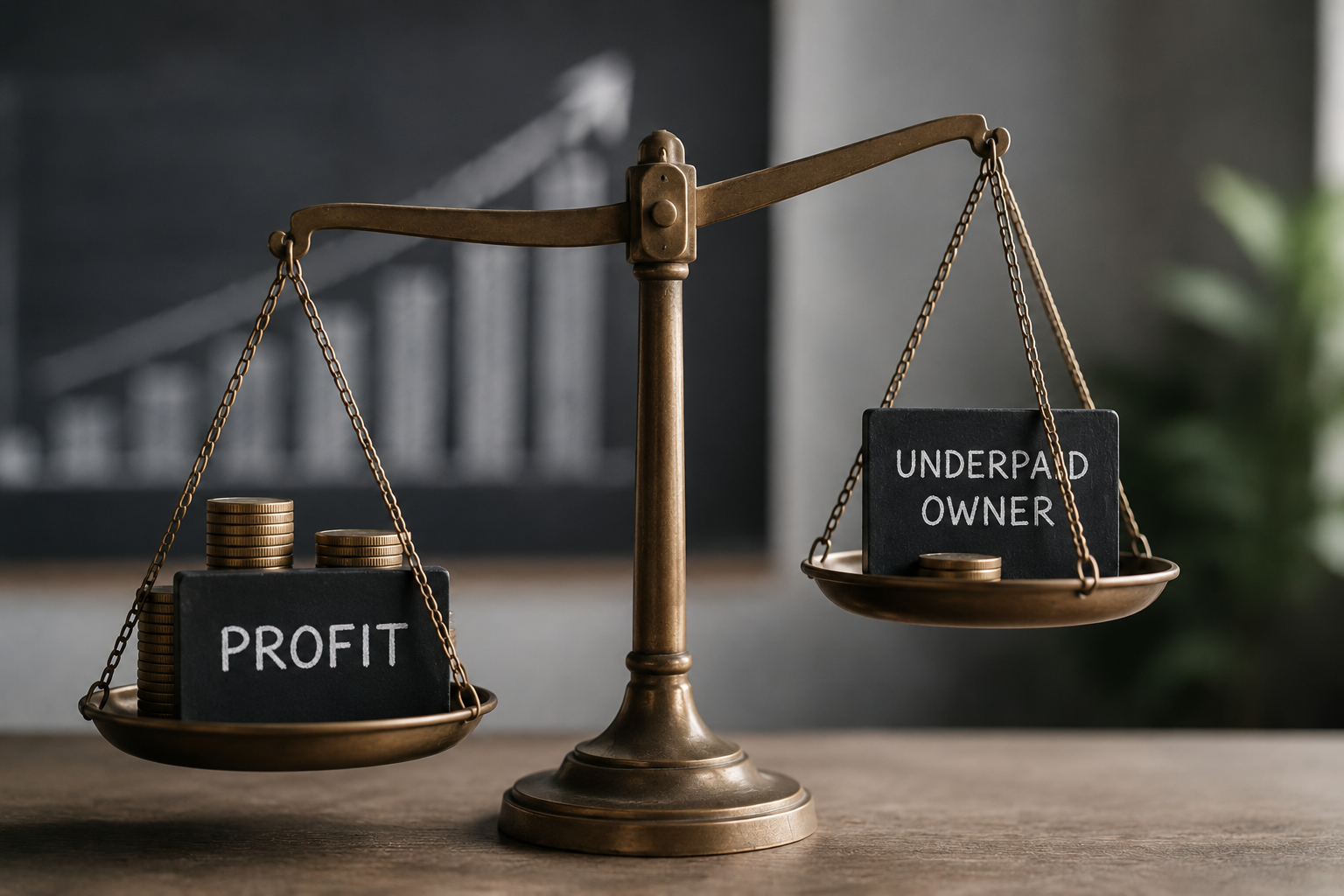
When a buyer or a valuer looks at your business, they do not accept your reported profit. They normalise it. If you pay yourself above market, they add the excess back and your profit rises. If you pay yourself below market, they deduct the difference and your profit falls.
Then they multiply.
Worked example. A business turns over $2M and reports $200,000 profit. The owner pays themselves $60,000. A replacement for that role costs $140,000 base plus 12% super, so $156,800.
Normalisation deducts $96,800. Maintainable earnings fall from $200,000 to $103,200.
At a 3 times multiple, the business is worth $309,600, not $600,000.
Underpaying yourself by $96,800 a year has cost roughly $290,000 of enterprise value.
The multiple is illustrative and varies widely by industry, size and risk. The mechanism does not vary at all.
So the owner who takes a small wage to "keep the profit in the business" has usually done the opposite. They have moved money from a visible line the market pays a multiple on, into an invisible one it does not.
Salary, dividends, drawings: what changes
| Structure | How you get paid | Tax | Super obligation |
|---|---|---|---|
| Sole trader | Drawings | All profit taxed at your marginal rate | None. Voluntary |
| Partnership | Drawings from your profit share | Your share taxed at your marginal rate | None |
| Company | Salary or director fees | Taxed personally, PAYG withheld | 12% compulsory |
| Company | Dividends | Paid from after-tax profit, can be franked | None |
| Trust | Distributions | Taxed at the beneficiary's rate | Depends on structure |
Three things owners get wrong here.
Drawings are not a salary. For sole traders and partners, drawings are not a deductible expense. You are taxed on the whole profit whether you take it out or not. This is the single most misunderstood point in Australian small business.
Director fees carry super. They are treated as salary or wages for superannuation guarantee purposes, even where the director is not otherwise an employee.
Dividends and drawings build no super at all. An owner who takes everything that way accrues nothing for retirement. Over twenty years, that is the difference between a funded retirement and having to sell the business because you have no choice.
Two dates that matter in 2026. The superannuation guarantee is 12% and has reached its legislated maximum. And from 1 July 2026, Payday Super applies, so superannuation must be paid on each payday rather than quarterly. If you run payroll, that removes a working capital float many businesses were quietly relying on.
Also worth knowing: the Division 7A benchmark interest rate for 2025-26 is 8.37%. Informal loans and mixed personal payments can be reclassified as unfranked dividends, which is an expensive way to find out you should have run a payroll.
What to actually do
Work out your replacement cost. What would you have to pay someone to do your job? Use the table above as a starting point and adjust for your industry and city.
Compare it to what you took last year. Include everything: salary, dividends, drawings, super, the car.
If there is a gap, that gap is your real margin problem. The business is not as profitable as the accounts suggest, and you now know by how much.
Set the salary first, then distribute what is left. Not the other way around.
Do not fix it by cutting your pay further. Fix it by fixing the business.
If the honest answer is that the business cannot afford to pay you properly, that is worth knowing this year rather than in three years when you try to sell it. A Business Analysis will tell you whether the gap is recoverable and where it is sitting.
Call me at 0491 729 043, or book a conversation at sarahcolgate.com.au.
Sources. ATO Taxation Statistics 2023-24. COSBOA and CommBank Small Business Perspectives Report, July 2025 (n=841). MYOB Business Monitor. Robert Half 2026 Australia Salary Guide. Indeed Australia salary data, August 2026. ATO superannuation guarantee rates and thresholds. Business valuation normalisation method per published Australian valuation guidance. The turnover-band mapping in the replacement-cost table is a synthesis, not a published survey. Nothing here is personal tax advice. Confirm your own position with your accountant.